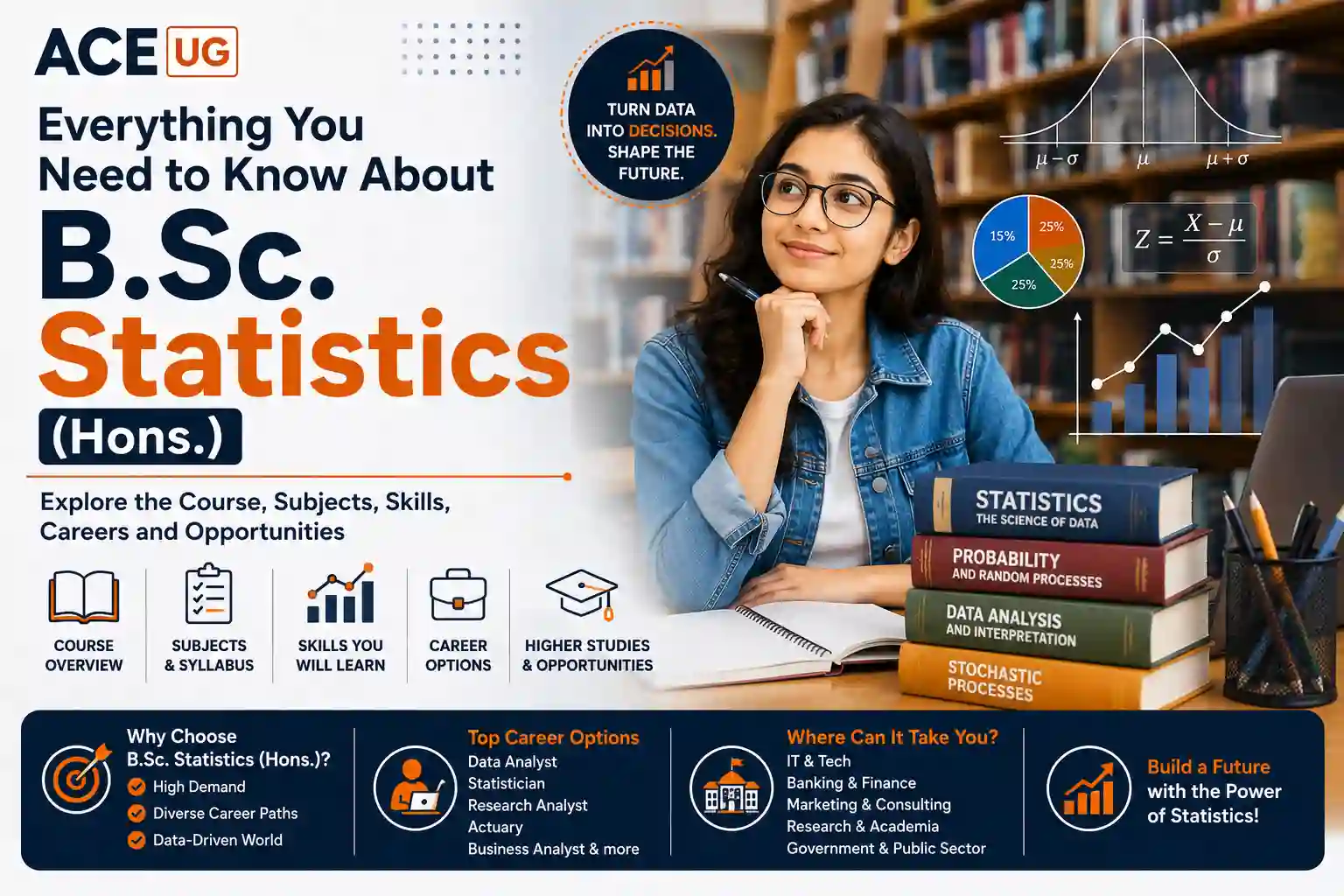
Everything You Need to Know About B.Sc. Statistics (Hons.)
B.Sc. Statistics (Hons.) is an undergraduate degree designed for students interested in mathematics, probability, data analysis, and scientific decision-making. The course teaches students how to collect, organise, analyse, and interpret data to solve real-world problems across industries such as banking, finance, healthcare, technology, government, and research.
With organisations increasingly relying on data to make decisions, graduates with strong statistical, mathematical, and computational skills can explore a wide range of career opportunities. Students can also pursue postgraduate education in Statistics, Data Science, Economics, Actuarial Science, and related fields.
If you are considering B.Sc. Statistics (Hons.) after Class 12, this guide explains the course, eligibility, syllabus, admission process, leading colleges, career options, and future scope.
What Is B.Sc. Statistics (Hons.)?
Bachelor of Science in Statistics (Honours) is a specialised undergraduate programme that focuses on the mathematical principles and methods used to analyse data. It combines theoretical learning with practical applications, helping students understand patterns, measure uncertainty, test assumptions, and draw conclusions from numerical information.
Unlike a general science degree, this programme places particular emphasis on probability, statistical inference, mathematical modelling, sampling techniques, and data interpretation. Depending on the university, students may also study programming, statistical software, economics, and data science.
The Indian Statistical Institute (ISI), for example, offers a Bachelor of Statistics (Honours) programme that includes statistical theory, mathematics, and basic computer science.
B.Sc. Statistics (Hons.): Course Highlights
| Particulars | Details |
|---|---|
| Course Name | B.Sc. Statistics (Honours) |
| Degree Type | Undergraduate |
| Stream | Science |
| Duration | Generally 3 or 4 years, depending on the university and programme structure |
| Eligibility | Class 12 qualification with Mathematics or Applied Mathematics, as specified by the university |
| Admission Process | CUET-UG, university entrance examination, merit-based admission, or another prescribed process |
| Main Subjects | Probability, Statistical Inference, Calculus, Algebra, Regression Analysis, Sampling |
| Practical Learning | Statistical computing, data analysis, projects, and laboratory work, depending on the curriculum |
| Higher Studies | M.Sc. Statistics, Data Science, Biostatistics, Actuarial Science, and related programmes |
| Career Options | Statistical Analyst, Data Analyst, Research Assistant, Business Analyst, and other quantitative roles |
Note: Course duration, eligibility, admission criteria, and degree titles vary across institutions. Always check the latest official admission brochure before applying.
Eligibility Criteria for B.Sc. Statistics (Hons.)
Students generally need to meet the following eligibility requirements:
For example, the Indian Statistical Institute requires Mathematics and English at the 10+2 level for its B.Stat. (Hons.) programme. Its selection process is based on written tests in Mathematics at the 10+2 level, subject to the institute’s admission rules.
Students should not assume that the eligibility criteria are identical across all colleges. Some institutions may also specify particular CUET subject combinations.
Admission Process for B.Sc. Statistics (Hons.)
The admission process depends on the university and the programme. Students should follow these general steps:
- Check eligibility: Confirm that you meet the Class 12 subject and minimum-mark requirements.
- Identify suitable colleges: Shortlist universities based on their curriculum, faculty, fees, location, and admission requirements.
- Register for the required entrance examination: Apply for CUET-UG or the institution’s own entrance test, wherever applicable.
- Select the correct subjects: Check the university’s prescribed entrance-test subject combination before submitting your application.
- Complete the university application: Some universities require a separate admission registration after the entrance examination.
- Participate in counselling or seat allocation: Follow the institution’s merit-list, counselling, or admission-allocation process.
- Verify documents and pay fees: Submit the required certificates and complete admission formalities within the deadline.
For students applying through CUET-UG, the National Testing Agency’s official information bulletin and the target university’s programme-specific eligibility rules should be checked together.
B.Sc. Statistics (Hons.) Syllabus
The syllabus typically combines mathematical foundations, statistical theory, applied analysis, and practical computing. The exact semester-wise structure varies by institution.
Core Subjects
1. Descriptive Statistics
Students learn to summarise and present data using measures such as mean, median, mode, variance, standard deviation, tables, and graphs.
2. Probability Theory
This subject introduces probability rules, random variables, conditional probability, and the mathematical foundations of uncertainty.
3. Probability Distributions
Students study distributions such as the binomial, Poisson, normal, and other probability models used to represent real-world events.
4. Calculus and Mathematical Analysis
Calculus and related mathematical concepts help students understand statistical formulas, optimisation, continuous distributions, and analytical methods.
5. Algebra for Statistics
Students develop mathematical skills required for statistical modelling, matrix operations, and other quantitative applications.
6. Statistical Inference
This area covers estimation, hypothesis testing, confidence intervals, and the use of sample data to draw conclusions about populations.
7. Sampling Techniques
Students learn how to select samples, design surveys, estimate population characteristics, and understand sampling errors.
8. Regression and Correlation
These methods help identify relationships between variables and estimate how one variable may be associated with another.
9. Applied Statistics
Applied topics demonstrate how statistical methods are used in business, economics, healthcare, industry, and scientific research.
10. Statistical Computing and Data Analysis
Depending on the university, students may work with tools and programming languages such as R, Python, spreadsheets, or specialised statistical software.
Practical Learning and Projects
Practical components can include data collection, survey design, statistical calculations, computer-based analysis, report writing, and research projects. Students should review the curriculum of their preferred college to understand which software tools and practical modules are included.
Best Colleges for Statistics in India
Students should compare institutions based on the exact degree offered, academic curriculum, admission requirements, research opportunities, fees, and career support.
Some institutions worth researching include:
1. Indian Statistical Institute (ISI), Kolkata
ISI offers the Bachelor of Statistics (Honours), a rigorous programme focused on statistical theory, mathematics, and applications. Admission is competitive and follows the institute’s own selection process rather than a standard CUET-only route.
Official website: https://www.isical.ac.in/
2. University of Delhi Colleges
The University of Delhi has offered B.Sc. (Hons.) Statistics through participating colleges. Students should check the current college list, programme availability, CUET requirements, and admission rules for their admission year.
Official syllabus and programme information: https://academicaffairs.du.ac.in/syllabi/department-of-statistics/
3. Panjab University, Chandigarh
Panjab University publishes syllabi for Statistics programmes, including honours-level study. Applicants should verify the current programme structure and admission route.
Official website: https://puchd.ac.in/
4. St. Xavier’s University, Kolkata
St. Xavier’s University offers a B.Sc. (Hons.) Statistics and Data Science programme. This may interest students looking for a curriculum that combines statistical methods with data-focused learning.
Official website: https://www.sxuk.edu.in/
5. Central University of Tamil Nadu
The university’s Department of Statistics and Applied Mathematics lists B.Sc. Statistics (Honours/Research) among its programmes. Students should review the latest eligibility and selection details.
Official website: https://cutn.ac.in/
How to Choose the Right College
Before making a final decision, compare:
A college’s reputation is important, but the suitability of its curriculum and the student’s own skill development also matter.
Career Opportunities After B.Sc. Statistics (Hons.)
A Statistics degree can prepare students for entry-level analytical roles and further specialisation. Job eligibility depends on the employer, role, technical skills, experience, and additional qualifications.
1. Data Analyst
Data analysts organise datasets, identify trends, prepare reports, and help organisations make informed decisions. Excel, SQL, Python, data visualisation, and statistical reasoning can be valuable skills.
2. Statistical Analyst
Statistical analysts apply statistical techniques to interpret data, evaluate trends, and support research or business decisions. Some specialised positions may require postgraduate qualifications.
3. Research Assistant
Graduates may assist researchers with data collection, survey design, statistical analysis, and report preparation in universities, research institutions, and private organisations.
4. Business Analyst
Business analysts study business performance, customer behaviour, and operational data. Communication, problem-solving, spreadsheet skills, and data interpretation are useful for these roles.
5. Banking and Financial Services
Statistics graduates may explore analytical roles in banking, insurance, financial services, risk analysis, and market research. Some positions require additional finance knowledge or professional qualifications.
6. Government Statistical Services
Students can prepare for relevant government recruitment examinations, subject to the specific educational requirements of each post. Certain specialist statistical positions require a degree with prescribed Statistics coursework or a postgraduate qualification.
7. Actuarial Science
Students interested in risk, insurance, and financial modelling can explore actuarial examinations and related career pathways. Progression typically requires passing professional examinations and building relevant experience.
8. Data Science
A Statistics background is useful for data science because probability, inference, and modelling are central to many data-driven methods. However, data scientist positions commonly require additional skills in programming, databases, machine learning, and applied projects.
Important: A B.Sc. Statistics (Hons.) degree does not automatically qualify every graduate for every role listed above. Check job descriptions and eligibility conditions carefully.
Salary After B.Sc. Statistics (Hons.)
There is no single salary figure applicable to all graduates. Earnings depend on the job profile, employer, city, practical skills, internships, academic performance, and whether the candidate has completed further education.
Entry-level analytical positions may offer different compensation from specialised roles in finance, technology, or research. Candidates with strong statistical reasoning and practical skills in tools such as Excel, SQL, R, or Python may be better prepared for relevant job opportunities.
Before choosing a college based on placements, examine its latest official placement report, the roles offered to Statistics students specifically, the number of students placed, and the reported salary figures. Overall college placement statistics may not accurately represent outcomes for a particular course.
Higher Studies After B.Sc. Statistics (Hons.)
Students who want to deepen their expertise or pursue specialised careers can consider several postgraduate and professional pathways.
Admission requirements differ by programme. Some postgraduate courses require a particular combination of undergraduate subjects, minimum marks, or an entrance examination.
Skills Students Should Develop During the Course
To make the most of a Statistics degree, students should build skills alongside their academic studies.
Projects, internships, and a portfolio of well-documented analyses can help demonstrate these abilities to prospective employers.
Is B.Sc. Statistics (Hons.) a Good Course?
B.Sc. Statistics (Hons.) can be a good choice for students who enjoy Mathematics, logical reasoning, and solving problems using data. It offers a foundation for careers and further study in statistics, analytics, research, finance, and related quantitative fields.
However, the course is mathematically demanding. Students should be comfortable working with formulas, probability, abstract concepts, and numerical problems. Those who prefer subjects with little mathematical content may want to compare other undergraduate options before applying.
The degree is most useful when students combine academic knowledge with practical tools, projects, communication skills, and a clear career plan.
Frequently Asked Questions (FAQs)
1. What is B.Sc. Statistics (Hons.)?
B.Sc. Statistics (Hons.) is an undergraduate programme focused on statistical theory, probability, mathematical methods, data analysis, and the interpretation of numerical information.
2. Is Mathematics compulsory for B.Sc. Statistics (Hons.)?
Mathematics or Applied Mathematics is commonly required at the Class 12 level. However, the precise subject combination and minimum marks depend on the university and programme.
3. Can Commerce students pursue B.Sc. Statistics (Hons.)?
It depends on the student’s Class 12 subjects and the institution’s eligibility rules. Commerce students who studied Mathematics or Applied Mathematics may be eligible for some programmes, but they must verify the requirements of each college.
4. Is CUET-UG required for admission?
Some universities use CUET-UG, while others may conduct their own entrance examinations or follow another selection process. For example, ISI uses its own written-test-based selection process for B.Stat. (Hons.), subject to its admission rules.
5. What is the duration of B.Sc. Statistics (Hons.)?
The programme may run for three or four years, depending on the university, degree structure, and applicable academic framework. Confirm the duration in the official programme details.
6. What subjects are taught in B.Sc. Statistics (Hons.)?
Common subjects include Descriptive Statistics, Probability Theory, Probability Distributions, Calculus, Statistical Inference, Sampling Techniques, Regression Analysis, and Applied Statistics. Some colleges also include programming and statistical computing.
7. What can I do after B.Sc. Statistics (Hons.)?
Graduates can apply for suitable entry-level analytical and research roles or pursue further study in Statistics, Data Science, Biostatistics, Actuarial Science, Economics, and related fields.
8. Is B.Sc. Statistics (Hons.) useful for a career in Data Science?
Yes. Statistics provides a foundation in probability, inference, and modelling, all of which are useful in Data Science. Students should also develop programming, database, machine-learning, and project skills.
9. Can I pursue an M.Sc. Statistics after this degree?
Yes, subject to the eligibility criteria of the postgraduate institution. Some programmes specify required undergraduate Statistics credits or particular combinations of subjects.
10. How should I select a college for B.Sc. Statistics (Hons.)?
Compare the curriculum, faculty, admission requirements, fees, practical learning opportunities, research exposure, and course-specific placement information. Choose a programme that fits your academic strengths and long-term goals.
Conclusion
B.Sc. Statistics (Hons.) is a strong option for students who want to understand data, mathematics, and quantitative decision-making. The degree can lead towards opportunities in analytics, research, banking, finance, government recruitment, and further study.
Before applying, check the eligibility requirements, entrance examination, syllabus, course duration, and fee structure of each shortlisted university. Building practical skills in statistical software, programming, and data analysis during the degree can also help students prepare for future academic and professional opportunities.